Thursday, June 12, 2014

Put Away the Guns Already--my heart is breaking!


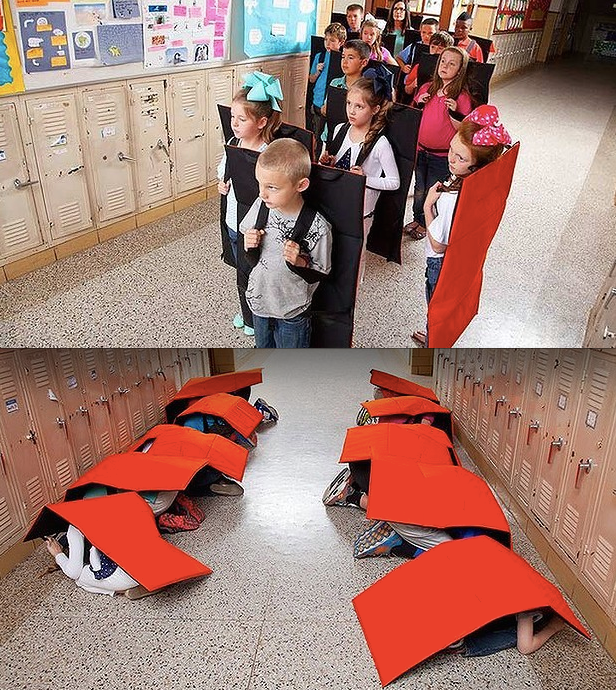
 These pictures are apparently a new advertisement for the “latest bulletproof” technology available to schools, parents, and children.  So you know, it’s also touted as “protective gear” for events like tornadoes. 

In the wake of more gun-related violence, hearts again are broken.  Not just any violence, like an angry outburst or an enraged response of someone hurt or spurned; instead insidious violence at a school.  I said to the congregation I serve in my sermon this past Sunday, after learning about another university shooting on the west coast—“prepare yourselves, there will be others.”  I didn’t think it would come in less than two days. 

I’m told that since the horrific day when the world learned the name of Columbine because of the violence that happened there, that there have been 149 gun-related events.  There were 75 in the 14 years between Columbine and the shooting at the elementary school in Newtown, Connecticut; and in the not quite two years since Newtown, another 74 events of gun-related violence. 

My heart is breaking.  After this week’s news, I found this picture circulating on the internet; part of a news report on an advertising campaign for a new kind of protective body armor that can be deployed in our schools.  My heart is breaking, because this kind of response is simply confirmation that we seem more than prepared to accept more death, more innocent deaths, more harm perpetrated by individuals and groups.  And we’d rather accept death in order to protect the rights to bear whatever kinds of weapons we deem fit, knowing for certain that this right will result in more deaths.  My heart is breaking. 


Here’s the thing.  While we cling to this right to have and use guns that so many see as most necessary—as if freedom itself depends on a loaded weapon with a finger on the trigger—we seem to have no view of Jesus and his ministry. 

Jesus never used a weapon of any kind against other human beings.  

Jesus, I’m convinced, would never hold a gun against any other human being for any reason. 

As Elias Chacour says in the inscription in each book he signs, “God does not kill.”  Further, Jesus asks his followers to put their weapons away when he is threatened with arrest: “Put your sword back into its place; for all who take the sword will perish by the sword.” 

Of course, a sword is a far cry from a gun or an assault rifle.  As some have observed, would the perpetrators of these violent incidents have used swords instead of guns, the death and damage likely would have been less and less costly.  No, Jesus doesn’t favor swords over guns.  Jesus clearly sides with beating swords and guns into plowshares. 

Last week, I watched a recorded segment of the Tonight Show with David Letterman in which the host, Letterman, in an interview with Anderson Cooper, declared in references to these shootings: “For the love of Christ, when are we going to do something about this nonsense.”  I don’t know about Mr. Letterman’s religious leanings or even if he is a practicing Christian; but it sounded like a siren-call for those of us who claim the name and life of Jesus. 

I don’t know how to practically go about beating our swords and guns into plowshares.  Abolishing the 2nd Amendment is likely not a political or reasonable solution.  We live too much in the shadow of guns; but hoping or aiming to ban them altogether hardly seems a winning possibility.  Jesus didn't banish swords; but he did say, put them away. 

To those who so vehemently defend the 2nd Amendment as if we cannot ever imagine reversing it, I ask you to consider the observation that the original constitution declares the right to life, liberty, and the pursuit of happiness.  These days, the 2nd Amendment right to bear arms and the resulting violence seems to stand stridently in conflict with the right to life, liberty, and the pursuit of happiness.  Even more menacing, increasingly it's innocent children who are victimized by this gun violence enabled by our zest for firearms. 

For me, while it is my right as a citizen of our great nation to have a gun, buy a gun, handle a gun, use a gun, I will not—for any reason.  And in order to save the lives of others, I believe a Christian witness worthy of Jesus, would be for all of us who claim his name to do no less than to put away our guns.  To voluntarily lock them up—effectively making them useless instruments of violence—figuratively beating them into plowshares. 

One of my Facebook friends, Aric Clark, observed in the aftermath of the time before last with one of these shootings, where pictures were circulating of people carrying assault rifles to places like Wal-Mart: 

If you own and openly carry an assault rifle in public spaces you are intentionally sending the message that you are capable and willing to cause massive bodily harm and death to other human beings. It is not irrational for other people to fear you. It is actually what you want. You are a dog baring your teeth. A gorilla beating your chest. Don't pretend it is innocuous to wave an assault rifle around. It is an open threat. 

These days, it simply stands to reason that ANY GUN is a threat.  And that EVERY GUN sends the message that the one holding it is capable—and willing if necessary—to cause massive bodily harm and death to others.  And even when that gun is in the hands of one of the “good guys”—like a soldier or a police officer—the threat is simple, “comply with what I say or I have the right to injure or even kill you.” 

Guns aren’t keeping us safe.  They trick us into believing that we don’t have to rely completely on God’s goodness.  They trick us into believing that the power we create for ourselves is better than God’s provision.  They trick us into thinking that we can have whatever we want without consequences if we can just hold the power in our hands and demonstrate it a time or two for others.  Like, “if the bad guys know we can shoot and kill them, they won’t be tempted to rob the bank.”  We feel the need to protect ourselves, but in that desperate attempt to feel safe, we put others AND OURSELVES at more risk. 

And instead of releasing the grip on the weapons, it will be the plan of many to simply try and clothe the would-be innocent victims in some sort of body armor.  Have fun playing on the playground under a bullet-proof blanket, kids! 

Even that can’t stem the tide; and in the meantime, we’ll live in fear.  How many days till the next shooting?  Since Columbine, the number of days is down to about one shooting per week.  Like Sabbath—one in every seven! 

Stop already.  STOP ALREADY!  My heart is breaking.  The losses are far too real--and unnecessary.  The chances are, the violence will only get closer and closer to home.  74 more events since Newtown; 149 episodes since Columbine. 

I can already begin to count when my own children must take their turn as victims.  Does it take that before I join the chorus—“for the love of Christ, why didn’t we when we had the chance.” 

In fact, why does it take any victim at all. 


Can’t we find a way, for the love of brothers and sisters and care for the world to simply put the guns away.  It’s about 2-3 days until another shooting.  


Friday, June 6, 2014

After Easter. Now what?

Christians celebrate Easter with the joy of new life, second changes, and the promise that death doesn’t have the last word.  Easter is grand, glorious, and hope-filled; and it lasts until Pentecost. 

Because the gospels portray Jews—and in particular the Jewish religious leaders, the scribes and Pharisees—in rather unflattering ways, it’s often forgotten that Jews and Christians share the 50 days between Passover and Pentecost.  Leviticus in the Old Testament recounts the “counting of days in chapter 23: 
 “You shall count until the day after the seventh sabbath, fifty days; then you shall present an offering of new grain to the Lord.”  
In that same timeframe, Christians are counting from the celebration of Easter.  And if this is news to you, it all comes together in Acts chapter 2 with the disciples gathered together and proclaiming in the native tongues of all the travelers on pilgrimage to Jerusalem to celebrate Shavout—the Festival of Weeks. 

Yes.  Christians and Jews share this sacred time, together.  A time of “counting.”  A time of “waiting.” 

But what happens when the counting and the waiting are over? 

Jews celebrate God’s gift of the Torah at Mt. Sinai.  Following the great escape from Egypt, God leads the people to Sinai and delivers the books and stories for God’s people to live by, including the Commandments gifted in those well-known tablets of stone. 

Christians celebrate the gift of the Holy Spirit.  Perhaps in similar ways, the reminder, the help, the power of God to live in relationship with God.  This time, no rigid tablets of stone—quite the opposite—the sound of a mighty rush of wind, flames of fire dancing over people’s heads, it’s the Advocate who helps us know what to say and do since Jesus has ascended or returned to God. 

Jesus, in several accounts of instructions to his disciples, followers, and believers, points out the ministry of caring for one another, treating one another with respect, and in a famous parable in Matthew’s gospel of the sheep and the goats says to us—“whenever you do unto the least of these, you do also for me.”  Undoubtedly that’s a part of going to all nations and baptizing them and teaching them.  And just as undoubtedly that’s what it means to be “witnesses” as Luke describes in Luke and Acts. 

For Jews, chapter 23 in Leviticus goes on to describe the conclusion of the “counting of days” with this observation and instruction:  “When you reap the harvest of your land, you shall not reap to the very edges of your field, or gather the gleanings of your harvest; you shall leave them for the poor and for the alien: I am the Lord your God.” 

It seems to me that Jews and Christians, as well as all people of great faith, share a vision of the world that includes care for one another—especially those who are suffering, especially those who don’t have enough, especially those who are at risk.  For Jews and Christians in particular, these days of counting and waiting end not just on a prescribed date, but when those who celebrate this time begin again to live into the covenant that God has shared with us and shown us.  For Jews, it’s the life Torah prescribes.  For Christians, it’s the life of the Torah lived out in Jesus. 

And somehow, Easter seems to lose some of its special meaning, if all we do is hold up a picture of an empty tomb without going forth to live the life Jesus teaches us.  Come Pentecost, the time of waiting is over.  The Holy Spirit comes to inhabit us and we are called to move with a purpose in the world—caring for one another, “doing unto the least of these,” and leaving the gleanings of the harvest for the poor and for the alien. 

Easter days are waning.  It’s time to move into (new) life with a purpose—sharing, witnessing, telling, doing for others. 


Wednesday, May 28, 2014

Chrysalis

This week the church celebrates the Ascension of Christ; and this coming Sunday we will celebrate the last Sunday of the season of Easter.  While everyone’s societal calendar will tell you that Easter was April 20th this year, EASTER is not a single date, but rather a liturgical SEASON. 

This EASTER, the congregation I serve has been trying to be mindful living an Easter life means being raised from an old life.  For Lent, we kept an eye on “leaving behind” certain parts of our lives, so that come an Easter resurrection we could emerge into a new, renewed life—hoping it wouldn’t be just for a day! 

I think the end of Easter is a better example than the beginning.  Jesus’ ascension reminds us that the disciples, followers, and believes are left awaiting a fuller transformation.  And come Pentecost (that we’ll celebrate on June 8th), the disciples, followers, and believers finally seem to become the embodiment of the Church.  While in the immediate aftermath of Jesus’ death and resurrection there are stories of fright, fear, discombobulation, and uncertainty; by the end of the Easter season there seems to be renewed excitement, new revelations, hope, and a new way of being emerges. 

Common Crow Pupa
These last few days, as Spring has more fully sprung, as the familiar creatures and bugs have emerged from winter, I’ve been thinking about the transformation and transfiguration afoot in the world and I’ve been thinking about chrysalides—the plural of “chrysalis.”  A chrysalis is the pupa form of a butterfly, and one of the images of Easter transformation. 


In the insect world, a chrysalis is the “in-between” stage of transformation and transfiguration during a caterpillar’s metamorphosis into a butterfly.  The caterpillar spins a cocoon, sheds its outer skin to help form a protecting cover, and transfigures itself—before emerging as something almost entirely new.  It’s amazing!  Some have likened this to Jesus in his death and resurrection—entering the tomb as a wrapped body and re-emerging as the “risen one.” 

As I encounter the stories of the disciples and the early church post Jesus’ resurrection, this is also something that seems to happen to the disciples and believers.  When Jesus departs for the last time from an earthly life, the responsibilities for his earthly ministry seem to shift from him to the disciples and the group of early believers.  And I’m wondering if we really “get” that? 

Following Jesus’ resurrection, Luke and Acts report that the disciples, followers, and believers were continually in the Temple and constantly devoting themselves to prayer—waiting in Jerusalem until they are clothed with power from on high.  Hmmm.  They enter that protected space, waiting to be transformed (or is it transfigured?).  When they emerge—we find them speaking, teaching, traveling, tending, and all around them are the acts and works of Jesus! 

There’s so much written and in conversation in church circles these days about changes happening in the church.  It’s the end of the great Christendom age—many think; we are dealing with changes and challenges unimagined; we are facing struggles amidst the reality of the decline in the numbers of people participating actively in churches.  Yet, there is an unprecedented hunger for the works and ways of Jesus. 

Perhaps this is our chrysalis-time as the church—in which we are being transfigured and transformed by individually and corporately.  What has been is not going to be in the same way.  What will be is not exactly who we are, now.  So…, as Easter comes to a close, will our life as the Church look different and be different as the scripture stories suggest it must be? 

For so many people, Easter morning is often portrayed as our “emergence”—“Up from the grave he arose with a mighty triumph o’er his foes…” declares the popular refrain.  But for the disciples and early believers, those early days of Easter are borne out sometimes behind closed doors, sometimes not being able to “see” Jesus at all, sometimes terrified about what this means or if they’ll be killed next, John even tells a story where the disciples all go home to Galilee; Mark ends without the women saying anything to anyone. 

No.  Easter requires us to stop and think, to reflect and take stock.  Almost as if we pull the covers over us tight on a cold winter’s night to hide in the darkness.  Or, like a caterpillar in a chrysalis-state. 

No.  This is the time of personal and corporate transfiguration and transformation.  We will soon be invited to take wing and fly.  It’s suddenly going to be EASTER everywhere! 

Cue the Avery & Marsh music, here. 

 “Every morning is Easter morning from now on!  Every day’s resurrection day, the past is over and gone!  Goodbye guilt, goodbye fear, good riddance! Hello Lord, hello, sun!  I am one of the Easter people!  My new life has begun! 


Wednesday, May 7, 2014

Steps and Steps Toward Home


I'm not preaching this coming Sunday--and it's been planned that way. We're celebrating Music Ministry Sunday in worship in our congregation; we're also celebrating and giving thanks for our congregation's 105 years of ministry; and—it’s Mother’s Day.  If I were preaching, it'd be harder than usual, I think. 

But mostly because I'm disheartened by the news this week of the nearly 300 young women who were taken captive and carried off in Nigeria, and the unfathomable lack of response to seek, find, and return those victims to their families.  I am angry and confused that the major news outlets could drone on and on day after day regarding the disappearance of Malaysia Airlines Flight 370--going to great lengths to describe the safety features and the technology deployed to find the missing plane, even when we all presume all of the passengers must surely have perished early on.  Yet, as news trickles in of next to nothing being done to find these young women, it seems there’s little more than a collective “shrug of the shoulders” going on. 

It is almost unimaginable.  And yet, it’s what we do.  It’s who we are—though some of us fight back against this reality. 


Mother's Day is not a liturgical holiday. I say that to the worship team every year as we make plans for observing it without naming it as such. I struggle each year knowing that for many women, the idea of Mother's Day is difficult, painful, and challenging. I "get it" and I'm always trying to find ways to help my congregation "get it" that Mother's Day is more than roses and Hallmark cards. But as we come to this year's observance that has such deep roots in our American culture, we're now face to face with this traumatic happening in another part of the world.

Say what you will about mothers and Mother's Day. We have nearly 300 mothers grieving the loss of children--who haven't suffered from some disease or accident, but who have been unmistakably and intentionally stolen. While we wrangle over the appropriateness of honoring mothers in worship, knowing the traumas of infertility, abuse, or thinking that “every woman wants to be a mother;” here are those whose precious babies have been ripped from their arms--and there's seemingly been little effort to go get and bring the babies back. 

Our lectionary scripture lessons this week put us in the liturgical cross-hairs of this trauma, too.  The famous 23rd Psalm—with it’s green pastures and still waters, fearing no evil in the valley of the shadow of death, and dining at the table prepared in the presence of mine enemies—leaves me wanting even though the opening verse would deny it!  And Jesus’ promise in the gospel from John 10--

“Very truly, I tell you, I am the gate for the sheep.  8All who came before me are thieves and bandits; but the sheep did not listen to them.  9I am the gate. Whoever enters by me will be saved, and will come in and go out and find pasture.  10The thief comes only to steal and kill and destroy. I came that they may have life, and have it abundantly.”

--seems only to serve to exacerbate my hopeless and helpless feelings.  THOSE WHO TOOK THE YOUNG WOMEN WERE THIEVES AND BANDITS!  AND JUST WHERE WAS THE GATE, TO PROTECT THEM, AND CALL THEM OUT/BACK JESUS? 

Aren’t we all now simply standing by as if these schoolgirls are just akin to the other schoolchildren who were victims of the ferry accident in South Korea?  As if they were lost by way of tragic accident and there’s no way we can get them back?  From which we now just have to “move on” and quit our whining! 


So—I have been heartened to know that this is never the only answer.  The writer of the Book of Acts points Christ-followers to this example:  “They devoted themselves to the apostles’ teaching and fellowship, to the breaking of bread and the prayers.”

And so, as the names of the lost ones were revealed this week, Christ-followers responded with encouragement that all of us pick a name of one of these victimized schoolgirls and pray for that one’s safe return, and for her mother and father, her family and community. 

All of us as Christ-followers can take that first step.  And hopefully, in that step, we will also find the courage and the voice and the urging to move beyond that step.  That we would raise our voices and dis-contentedness to make a difference—to cajole those with the power and authority to do something other than just standing by and hoping this news cycle will pass. 

And that as we take our steps toward home—that is the way and the witness and the will of the Kingdom of God—the world might see our faithful witness, and see in us that which we are and shall be.  And in that dawning, the world will be resurrected and made new. 


It’s Easter.  Jesus lives again.  We live again.  Those lost must be found.  


Tuesday, April 29, 2014

CHECK YOUR FUEL GAUGE

Between Philadelphia and the Jersey shore a common, familiar route is the Atlantic City Expressway.  By my standard it’s just not that far; nonetheless, along the express toll way there’s a service area, and as you approach there’s this sign: “check your fuel gauge.”  No doubt it’s a good practice.  No doubt many a driver has been “caught out” along the way to the shore not remembering to “check the fuel gauge” until after passing the service area.  But the fact is, it’s just not that far from the service area to the next exit (less than 7 miles)—and it’s only a few more miles to Atlantic City!  Though I’m sure it happens a lot, I just don’t get the urgency.  It’s not like rural Nebraska where there were signs and reminders like this: “next exit, 81 miles.” 

The gospel this week takes us from Jerusalem to Emmaus (about 7 miles) and from Emmaus to Jerusalem (about 7 miles).  Two of Jesus’ followers were traveling to Emmaus (it seems like they were going home from the festivities in Jerusalem) and they end up making the journey with Jesus himself (though their eyes were prevented from seeing that it was Jesus).  The story seems to blossom when Jesus is invited to stay with the followers, and the jig is up when Jesus breaks bread for the supper and they recognize him immediately.  Mysteriously, Jesus then vanishes and his followers head back to Jerusalem to make a full report of their experience. 

This week I’ve been reminded of just how far 7 miles can be and what it might mean as news reports have again circulated regarding the horrific damage sustained in southern states, including Arkansas.  I lived in Arkansas growing up and later served a congregation in Hardy.  I know the names and places of lots of towns—even the small ones that don’t make the news unless something awful happens—like Mayflower and Vilonia.  Fercliff Camp and Conference Center, where I attended many a church and camp function, reported damage from the storms was less than 7 miles to the west in the Brushy Mountain area.  Ferncliff itself was unscathed. 

Better check your fuel gauge—believe it or not, 7 miles makes all the difference.  I can’t explain it.  I still remember the sinking feeling in my stomach driving along the highway in Nebraska witnessing perfectly undamaged and healthy corn on the left side and totally ravaged, hail-destroyed stripped stalks on the right side. 

For Jesus’ followers, their mission objective changed quickly.  They made a sobering trip home only to turn around and make an excited return trip to Jerusalem back-to-back—with barley any time to eat!  For the last couple of days it’s felt like that as storms have made their way across the country leaving a path of death and destruction and lives that won’t ever be the same.  And 7 miles can make all the difference! 

This week, “check your fuel gauge” seems to mean something a bit different to me.  If we’re in a position where we have plenty of fuel, we would do well to share with those who have been caught out.  As one of my friends reminded me a couple of tornado stories ago, “people need your prayers, but even more, that extra $20 you’ve been saving for something special.”  And while the call to “check your fuel gauge” is a call to help those who have been harmed or damaged by the weather, it should also be a reminder to consider those who struggle every day though no thunderstorm has supplanted them.  “Check your fuel gauge”—not with regard to what you might need; but with regard to what you already have to share. 

If you have fuel to help, Presbyterian Disaster Assistance responds immediately to afflicted people in the United States and around the world and is often the first (or one of the first) agencies responding when need erupts; they can use it.  You can find more information about PDA, including how to make a donation by clicking HERE


Remember, Jesus’ followers—not knowing they were traveling with Jesus—invited and implored the stranger (who ended up being Jesus, and who seemed content to continue his journey) to “stay with them” at least for a meal.  A meal that ended up making all the difference.  You’ve asked Jesus to “stay with you.”  There are people who need us to “stay with them,” too.  Now, more than ever.  

Tuesday, April 22, 2014

Road Trip!


I call the week after Easter the “post-Easter euphoria.”  It’s mostly because Lent and Holy Week—in particular—seem the busiest times for pastors.  And now that I have school-aged children, it just so happens that Spring Break is also Holy Week—which means, of course, that my kids spend most of their Spring Break father-less.  So for the last few years, we've been practicing an Easter Monday Adventure.  It’s a hold-over from my time serving churches in small communities where taking a break necessitated “getting out of town.”  So, in the post-Easter euphoria we leave town. 

I feel like we’re in good company.  Because by one gospel story or another that’s exactly what happens for Jesus’ followers—at least, that’s what’s SUPPOSED to happen.  The message of the angel on Easter morning is: “go quickly and tell his disciples, ‘He has been raised from the dead, and indeed he is going ahead of you to Galilee; there you will see him.” 

From Jerusalem of the cross and grave back to the shores of the Sea of Galilee—where the disciples first met Jesus—is about as far as it is for my family and I to get to the seashore from our home in suburban Philadelphia.  I imagine the disciples and those following Jesus would have appreciated the Atlantic City Expressway in their day, too! (OK, maybe not).  But my point is that come post-Easter Monday, they were on the road, too.  The post-resurrection stories differ in the details, but my best bet is that at some point, in the days following Easter, Jesus’ followers “went home”—to Galilee and the water. 

It’s a bit anti-climactic.  Mark’s gospel ends with the stark reality: “So they went out and fled from the tomb, for terror and amazement had seized them; and they said nothing to anyone, for they were afraid.”  The gospels end without any real resolution beyond Jesus being raised.  There are some appearance stories, but then what? 

For me, Easter Sunday simply gives way to the “Post Easter Euphoria.”  Followers get on the road again, and Jesus continues to show up.  Us too. 

For some, this seems surprising.  When we see Jesus die, we aren’t ever quite ready for the stark reality that he lives again.  I’m thinking about the disciples on the road to Emmaus—whom Jesus surprises in the breaking of the bread in Luke; or the disciples in John’s story when Jesus simply walks through the closed, locked, doors. 

But for me, I seem more eager to discover where Jesus is showing up in my world.  And the road seems the perfect place.  Where someone else makes a meal for us.  Where we bask in the beauty of the natural world.  Where our family has time together.  Where we learn something new.  Where we find interesting things.  Where we share in God’s love. 


Where are you seeing Jesus in his resurrection?  What kind of journey out of your normal routine gives way to our Lord’s presence in your midst?  And do you ever go and tell others of us, that we can see him, too?  

Wednesday, April 9, 2014

Between Bethany and Jerusalem

This week, we’re between Bethany and Jerusalem.  Bethany, of course, the site of last week’s gospel reading where Lazarus was raised; and Jerusalem, where Jesus enters the city in this week’s gospel story, also where Jesus will die.  

It’s just not that far from Bethany to Jerusalem—the Bible says about two miles.  I’ve been thinking about that thinness—as I walked a 5K this week (about 3 miles) and most mornings I try and walk at least 5 miles.  It’s only about 7 miles from my suburban home to Center City Philadelphia.  It’s just not that far—but so much goes on in between!  

I’ve been thinking for the past week about the distance between the church world I grew up in (of the 1980’s and 1990’s) and the realities of the world the congregation I serve today faces.  It’s the wrestling between technical change and adaptive change; and it comes in the form of the temptation to tweak what we have going on, or to try and adopt “best practices” from other churches that appear more successful rather than simply embracing who we believe God calls us to be.  Deep down, we all have some sense of why our faith is important and the things we want our faith to accomplish.  But we don’t always know this shouldn’t just be another church program.  I grew up seeing how church changed lives.  Some days it seems like a small gap from then till now; other days it’s a chasm.  

Spiritually, this week seems huge.  On Sunday Jesus marches forthrightly into Jerusalem, his face fully intent, his chin seemingly chiseled, his nerves steeled for everything that’s coming.  But he’s just emerged from raising the dead to life!  Surely Jesus doesn’t raise Lazarus to life only for him to die again.  

For Lent, one of invitations for our congregation has been to identify “the things we’d like to leave behind” when Lent is over.  More intentionally, the things we’d like to be met by Jesus in the resurrection so that we are unburdened of them, they are removed, and we are left to live in the new life Jesus promises.  As a part of our liturgy on Sunday we will march these “leavings” into Jerusalem with Jesus on Sunday.  We will give them up, hand them over, and in an act of seeking release from them we will release them ourselves and ask God to release us from them.  

The new world we face isn’t that far away from the old one.  But like the gospel itself, the new world challenges us to live in new ways.  It’s not about “giving up something for Lent.”  Having walked that road, we know small sacrifices or larger ones have the potential to radically change us.  As we walk into Jerusalem with Jesus, how resolute will we be about the things that we know need to change?  How chiseled can we carry our chin?  How committed to the real work of the gospel truths?  And do we remember we are bringing with us not the stench of death, but the sweet smell of resurrection?  

On to Jerusalem.  

Wednesday, April 18, 2012

Wednesday, April 18, 2012 Musings


Reflecting on John 15: 1-11

I dislike yardwork.  I don’t do it often--only when absolutely necessary!  My idea of “pruning” is simply mowing over!  And while I think I have a handle on Jesus telling followers about “removing every branch that bears no fruit,” I don’t have much experience with such caretaking.  

I’ve heard a lot of sermons and read a lot of comments about the necessity for “pruning” for the health of the plant.  Of Jesus, offering to “prune” followers and believers to maximize our fruit-bearing potential.  Of pastors needing to learn how to prune the flock.  Of reminding the church that not everyone is going to bear fruit.  Often, though I know it’s molded after what gardeners can do with their plants, it sounds to me like Jesus is abiding in some, but mowing over others.  I just don’t think that Jesus looks at the world like I look at yard work.  

In verse 4 Jesus says, “Abide in me as I abide in you.”  Which I take to mean that Jesus abides in us--already.  This is good news.  Jesus abides in me, already; the first step doesn’t depend on me making the right decision.  And then, Jesus turns around and says, “those who abide in me and I in them bear much fruit.”  And God is glorified when we bear much fruit and become disciples of Jesus.  

I think this is important to remember.  God is glorified when when we bear fruit and become disciples.  There isn’t much gain when branches are thrown away, withered, and get gathered and thrown into the fire and burned.  God is glorified only when the branches are healthy.  This keeps me from reading this passage with an eye toward the pruning and helps me to understand why Jesus abides in us, already.  

We have the Advocate, we have Jesus who abides in us--reminders that it is possible for us to keep commandments, bear fruit, and for our joy to be made complete.  All I know is that this feels different than if I’m looking out for Jesus coming at me with a pruning hook!  It’s a Jesus who cares for me, who loves me, who abides in me, who promises to send the Advocate, who wants me to abide in him, who needs me to bear fruit and so is already invested in my bearing fruit.  

It reminds me of God who sees human beings and calls us “good.”  When it’s all too easy to look at us as human beings, now, because we’re so “bad.”  I have enough witnesses reminding me about how bad things are--from the news media to church members’ complaining about this and that to people dissatisfied with the way things have become.  There’s the constancy of war and deprivation.  The world can be a bad place, and much of the blame can be put on the shoulders of human sin.  Yet, still, God is glorified as Jesus abides in us and we abide in him.  This is good news, indeed.  

Tuesday, April 17, 2012

April 17, 2012


Reflecting on John 14: 18-31

I have always liked the “Advocate” in chapter 14 of John’s gospel.  “Advocate”--in English, the synonyms are: supporter, backer, promoter, believer, activist, campaigner, sponsor.  And since I first encountered this passage in English as a boy, I’ve always thought that “Advocate” sounded a lot better than “Holy Spirit.”  An “Advocate” was someone who likely had your back; the “Holy Spirit” seemed and still does seem a lot less certain.  

So it’s “good news” in my mind that the “Advocate” Jesus promises, “will teach you everything, and remind you of all that I have said to you.”  Because the measure for loving Jesus is keeping his commandments--which sometimes seem a little less direct than the Ten Commandments inscribed on stone tablets!  Jesus says, “don’t let your hearts be troubled,” I think in part, because the Advocate has our backs.  

But that doesn’t get us entirely off the hook.  There’s still the matter of keeping the commandments.  Don’t worry, says Jesus, you have the Advocate to teach and remind.  But still... the commandments.  

This passage ends with Jesus saying: “ ...the ruler of this world is coming.  He has no power over me; but I do as the Father has commanded me, so that the world may know that I love the Father."  I don’t know who “the ruler of this world” is; it could be Pilate or the religious authorities--maybe both.  But though the ruler of this world is coming, Jesus says, “he has no power over me.”  Still, “I do as the Father has commanded me, so that the world may know that I love the Father.”  In other words, the ruler of this world doesn’t have the power to make him keep the commandments or love the Father, but Jesus does as he was commanded--”so that the world may know he loves the Father.”  

Jesus wants the world to know that he loves the Father; Jesus wants us to love the Father--and he tells us that when we keep his commandments, we love him, and when we love him, we love the Father.  And then I begin to see it more clearly--the ruler of this world is what’s in my way.  Not Pilate, not the religious authorities of Jesus’ day--the ruler of this world.  And there are many who rule this world.  

The culture.  Political leaders.  My own sense of right and wrong.  My desire for money, wealth, success, prosperity; my demand for freedom to do as I want, my selfishness, the selfishness of others--and the list goes on and on.  On any given day there’s a lot that affects my willingness or my desire to keep Jesus’ commandments in the face of worldly rulers.  

And that, too, is why I like this “Advocate”--who not only is going to have my back, but who is determined to help me do what I am not always prepared and/or willing to do for the sake of someone or something else.  Or, for the sake of loving the Jesus and the Father.  

Monday, April 16, 2012

Monday, April 16, 2012


I heard a conversation on the radio this morning about whether or not Jesus advocated for larger or smaller government.  On the one hand, the whole disagreement seems rather trite—aimed more at the personal gain of too few and at the expense of many others.  But Jesus says to us: “If you love me, you will keep my commandments.  And I will ask the Father, and he will give you another Advocate, to be with you forever.” 

Jesus says that I need another advocate.  Or taken in the broader sense, Jesus says that Christians need another advocate.  Government large or small aside, this seems surprising. 

In my culture, high value is placed on personal freedom and responsibility.  Many people believe that your future is what you make—that it shouldn’t have to do with your race, nationality, creed, or condition.  And we’re used to understanding, presuming, and believing that if we want to believe and follow Jesus, we just do it—it’s up to us.  So it’s surprising to hear Jesus totally put the brakes on that!  “I will ask the Father, and he will give you another Advocate, to be with you forever.  …[This Advocate abides with you, and will be in you.” 

In a way, Jesus is saying, “it isn’t up to us”—alone; it’s at least going to be us and the Advocate. 

That I need another advocate sounds strange in a world built around self-reliance and personal responsibility.  But I find it’s also “good news” for me—in a world that puts enormous expectations on us to “do it ourselves.” 

But the starting place for Jesus’ words about the Advocate come in the context of keeping Jesus’ commandments—if we love him.  I like to think that “I love Jesus,” but I also seldom ask whether or not I’m keeping all his commandments.  The truth of our human condition is like when I ask my young children if they “were good” at an event or for a shopping trip with their mom—meaning, did they act respectfully and comply with mom’s requests.  They sometimes say, “I was MOSTLY good; I was just a little bit bad.” 

I suspect that when we ask ourselves in earnest if we “love Jesus,” and the measure is “keeping Jesus’ commandments”—most of us have to concede something lacked.  Does that mean we don’t love Jesus?  I don’t think so.  Because we have another Advocate.